
occupation
Career soldier, agricultural labourer,
timekeeper at cement works
dates
Born: 10 Jan 1883, Saunderton, Bucks
Married: Minnie HOLLAND, 25 Mar 1912,
Shirburn, Oxon
Died: 9 Feb 1954
residence
Kidlington, Oxon (from before 1939 until 1954)
submitted by
Patricia Ellen FLORES, formerly O’DWYER
(granddaughter)
copyright information
The pictures shown here are in the collection of Patricia FLORES. They should not be reproduced without permission.
related faces
Minnie RACKSTRAW, née HOLLAND (wife)
Background information
Albert Edward RACKSTRAW was born at the Union Workhouse, Saunderton, Bucks. His parents were Amos RACKSTRAW and Sarah SMITH (married 20th August 1882 at Loudwater, Bucks). On the 1891 census they had disappeared and Albert was living with Stephen GOMME and his wife, Hannah ROGERS and another boarder, Herbert (Bert) WINNE. They both joined the Ox. & Bucks. Light Infantry in 1901 and served in World War I.
Albert was hit by shrapnel in his head and chest, and gassed by his own side. He was discharged on 17th December 1918 as acting master sergeant “being no longer physically fit for War Service”. He had lost sight in one eye and lived until death with shrapnel in one lung. He stayed in touch with his foster brother, Herbert WINNE.
Albert may not have known that he had two real brothers who were raised in foster homes: Thomas William RACKSTRAW
(b. 5th September 1884 at The Marsh, Wycombe, Bucks.) and Charles Henry RACKSTRAW (b. 1st September 1886 at the Union Workhouse, Saunderton, Bucks.)
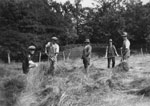
After WWI, Albert and his family lived at Shirburn, Oxfordshire where he worked for the Earl of MACCLESFIELD. Then he found a job as cowman working for his former superior officer Colonel BALLARD at Over Worton.
Upon becoming unable to perform the work because of illness, Albert and Minnie and their teenaged children moved to Kidlington where Albert eventually found work at the Bletchingdon Cement Works, staying until retirement.

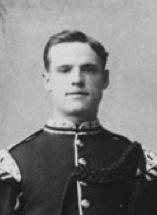
Albert Edward RACKSTRAW
Harvesting at over worton circa 1920-30